Support / Article
Why clients ask for status updates even when work is progressing
Why visibility matters as much as progress, and what clients need to see to feel confident about their work.
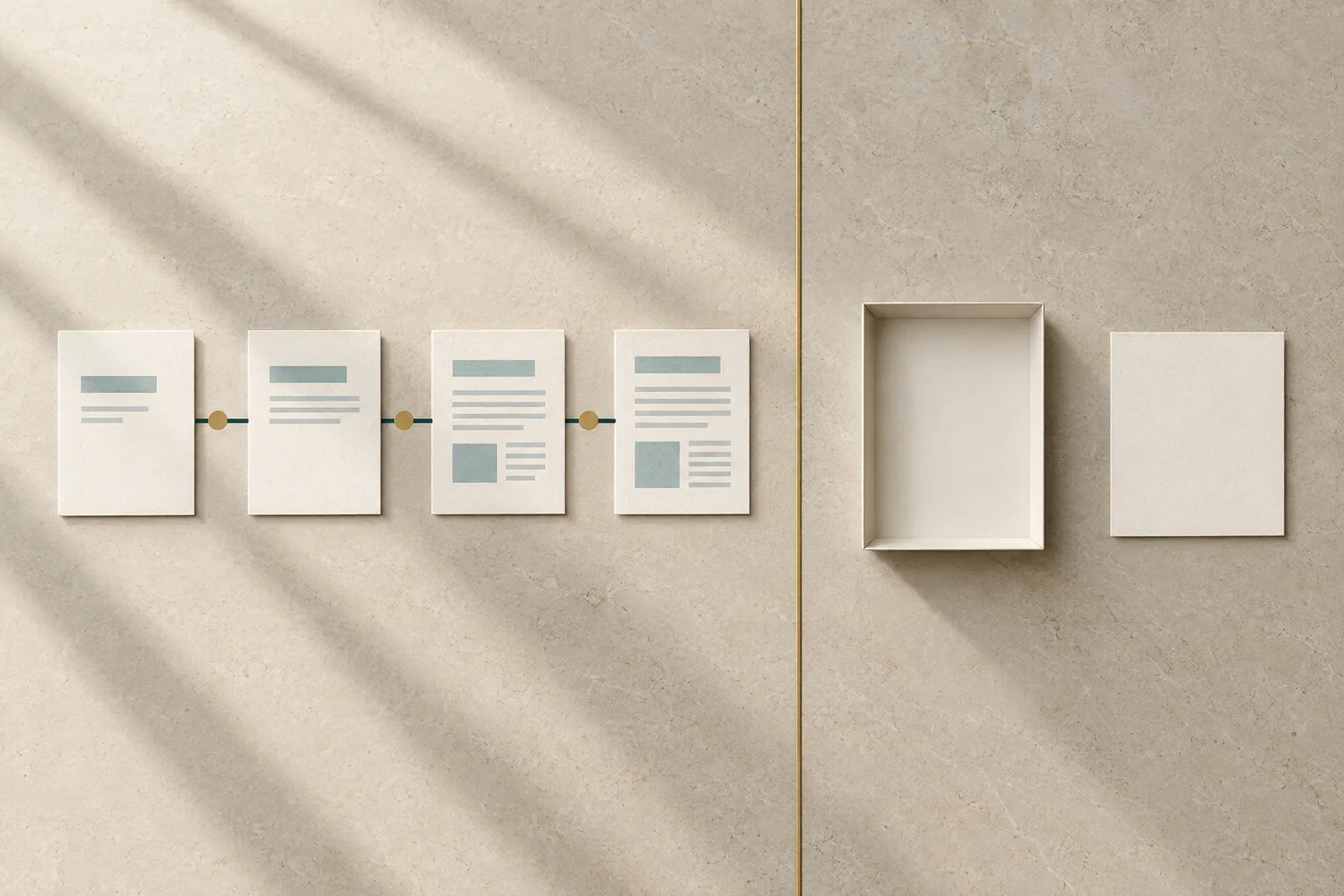
It is one of the more frustrating experiences in client work. The project is on track. The team has been working steadily. Then an email arrives from the client: just checking in on where things are. Sometimes it is polite. Sometimes it has an edge.
It is tempting to read these messages as impatience or a lack of trust. More often, they are a symptom of something simpler. The client cannot see the work. From their side, steady progress and no progress look exactly the same. This article explains why status requests happen, what research on waiting and transparency suggests and how to design visibility into client work.
From the client's side, silence is ambiguous
Most client work happens out of view. Research, drafting, building, reconciling and reviewing take place inside the service provider's business. The client sees the start of the project and, eventually, the deliverable. In between there is often very little.
That gap is easy for the provider to underestimate because the provider can see the work. The team knows the draft is half finished and the review is booked for Thursday. The client knows only that they have not heard anything since the kickoff call.
When a client asks for an update, they are usually not asking whether you are working. They are trying to resolve uncertainty: is this on track, is anything needed from me and when will I see something?
What research on waiting suggests
David Maister's essay The Psychology of Waiting Lines, written in the 1980s and still widely taught in service management, sets out a series of propositions about how people experience waiting. Two are especially relevant to client work. Uncertain waits feel longer than known, finite waits. Unexplained waits feel longer than explained waits.
Maister's examples come from queues, such as a patient told the doctor will be thirty minutes late versus one told the doctor will be free soon. The first can relax. The second spends the whole time on edge. A client waiting for a deliverable is in a similar position. If they know the first draft arrives on the fifteenth and why, they can plan around it. If they have been told it will be soon, every quiet day adds tension.
What research on transparency suggests
A second body of research looks at what happens when customers can see work being done. In a 2011 paper in Management Science, Ryan Buell and Michael Norton described what they called the labor illusion. In a series of online experiments, people who could see a service working on their behalf, for example a travel search showing the sites it was checking, valued the service more and in some conditions preferred it to an identical service that returned results instantly without showing the work.
Buell later summarized this line of research in a 2019 Harvard Business Review article titled Operational Transparency, arguing that organizations should deliberately design windows into their operations so that customers can appreciate the value being created.
These studies were not conducted on professional service relationships, and it would be wrong to claim they predict how any particular client will feel. They do support a practical intuition: showing clients the work, and not only the result, tends to increase confidence rather than invite micromanagement.
Why status requests are a cost, not just an annoyance
Each status request costs something on both sides. Someone on the team stops what they are doing, finds out where the work stands, writes a reply and returns to their task. The client spends time asking and waiting for the reply. If several clients ask in the same week, that is a meaningful amount of coordination work that produces nothing new.
There is also a relationship cost. A client who has to ask repeatedly may start to feel that they are managing the provider, which is the opposite of what they are paying for. And a provider who answers the same question many times may become defensive. Neither helps the relationship.
How to make progress visible
The goal is not to send more updates. It is to make the status available before the client needs to ask.
Share the plan at the start. At kickoff, show the client the stages of the work, roughly when each will happen and which steps need something from them. This turns an uncertain wait into a known one.
Set an update rhythm and keep it. A short weekly update, sent on the same day every week, does more than frequent ad hoc messages. Clients learn that they do not need to ask because the update is coming.
Give clients a place to look. A shared space where clients can see the current stage, recent activity, upcoming milestones and anything waiting on them reduces the need to ask at all. In AvariHQ, client portals give clients a defined place for shared files, requests and project information, connected to the work in Projects & Delivery.
Explain delays early. Maister's point about unexplained waits applies most strongly when something slips. Telling a client that a deliverable will be two days late and why, before the original date passes, is far better than letting them discover it.
Make the client's own actions visible. Many projects wait on the client for approvals, information or access. Showing clearly what is waiting on them, and since when, keeps the conversation factual.
What a good status update contains
A useful update is short and answers the client's real questions. Where are we in the plan? What was completed since the last update? What happens next and when? Is anything needed from you? Are there any risks or changes to timing?
Five lines that answer those questions are more reassuring than a long narrative. Consistency matters more than length.
Write updates in the client's language rather than your internal shorthand. A client does not need to know that a ticket moved to QA. They need to know that the first version is built and is being checked before they see it on Thursday. Plain language also makes the update easy for the client to forward to colleagues who were not part of the project.
When a client keeps asking anyway
Even with a clear plan and regular updates, some clients will continue to ask for status. It is worth understanding why before deciding how to respond.
Some clients report upward. They need to brief a manager, a board or a partner and are asking because someone is asking them. For these clients, an update written so it can be forwarded without editing is more useful than more frequent updates.
Some clients have been let down before. A previous provider may have gone quiet before missing a deadline. More visibility early in the relationship, and a little more personal contact, usually builds the trust that reduces the questions later.
Some clients have a deadline the business does not know about. A launch, an audit or an event can make a client anxious about timing that looks comfortable from the provider's side. Asking directly at kickoff whether any dates matter outside the project plan surfaces these early.
And sometimes a status request is really a different question. A client asking how things are going may be uneasy about a decision, unsure about the direction of the work or worried about cost. Answering the status question and then asking whether there is anything else on their mind often brings the real concern into the open.
A practical example
A small web studio notices that clients often email mid-project asking whether things are on track. On review, the projects usually are on track. The studio was simply silent between the kickoff and the first design review.
The studio makes two changes. At kickoff, it shares a one-page timeline showing six stages, approximate dates and the two points where client feedback is needed. And every Friday, the project lead sends a five-line update covering progress, next steps and anything waiting on the client. Within a few projects, unsolicited check-in emails become rare, and the ones that do arrive are about real questions rather than reassurance.
In summary
Clients ask for status updates when they cannot see progress, not only when progress is slow. Uncertain and unexplained waits feel longer, and research on operational transparency suggests that seeing the work increases confidence in it.
Share the plan, keep a reliable update rhythm, give clients a place to look and explain delays early. For examples of how different businesses structure client visibility, explore AvariHQ Solutions, or start a free trial to set up a shared client space of your own.
Free tool Excel
Client Support Triage Worksheet
More from AvariHQ Resources
- AcquireHow to create a clearer path from inquiry to qualified opportunity
- OnboardWhy client onboarding breaks down after the sale
- ConvertWhat makes a client handoff reliable
30 days free. No credit card required.